KnowledgeCore
by TechnoNet Sdn Bhd
Product Walkthrough · How it works end-to-end
Ask a question.
Get a cited answer.
In seconds.
KnowledgeCore turns your compliance documents into a searchable knowledge base. No keyword searching, no PDF archaeology, no guessing. Ask in plain language — get precise answers with full source references.
Try the Live Demo →The workflow
Four steps from question to answer.
01
Upload documents
PDF, DOCX, XLSX. Drag into the ingest directory. Pipeline runs automatically — 200 pages in about 11 minutes.
02
Ask in plain language
Type the question as you'd ask a colleague. No keywords, no Boolean operators, no query syntax.
03
System retrieves and reasons
Hybrid search finds relevant passages. The AI grades chunks for relevance, checks coverage, then generates the answer. All on your hardware.
04
Cited answer delivered
Answer streams in under 3 seconds. Every claim tied to a source document and section. Sources listed below the answer.
Interface walkthrough
What you see when you use it.
Screen 1 — Query interface (empty state)
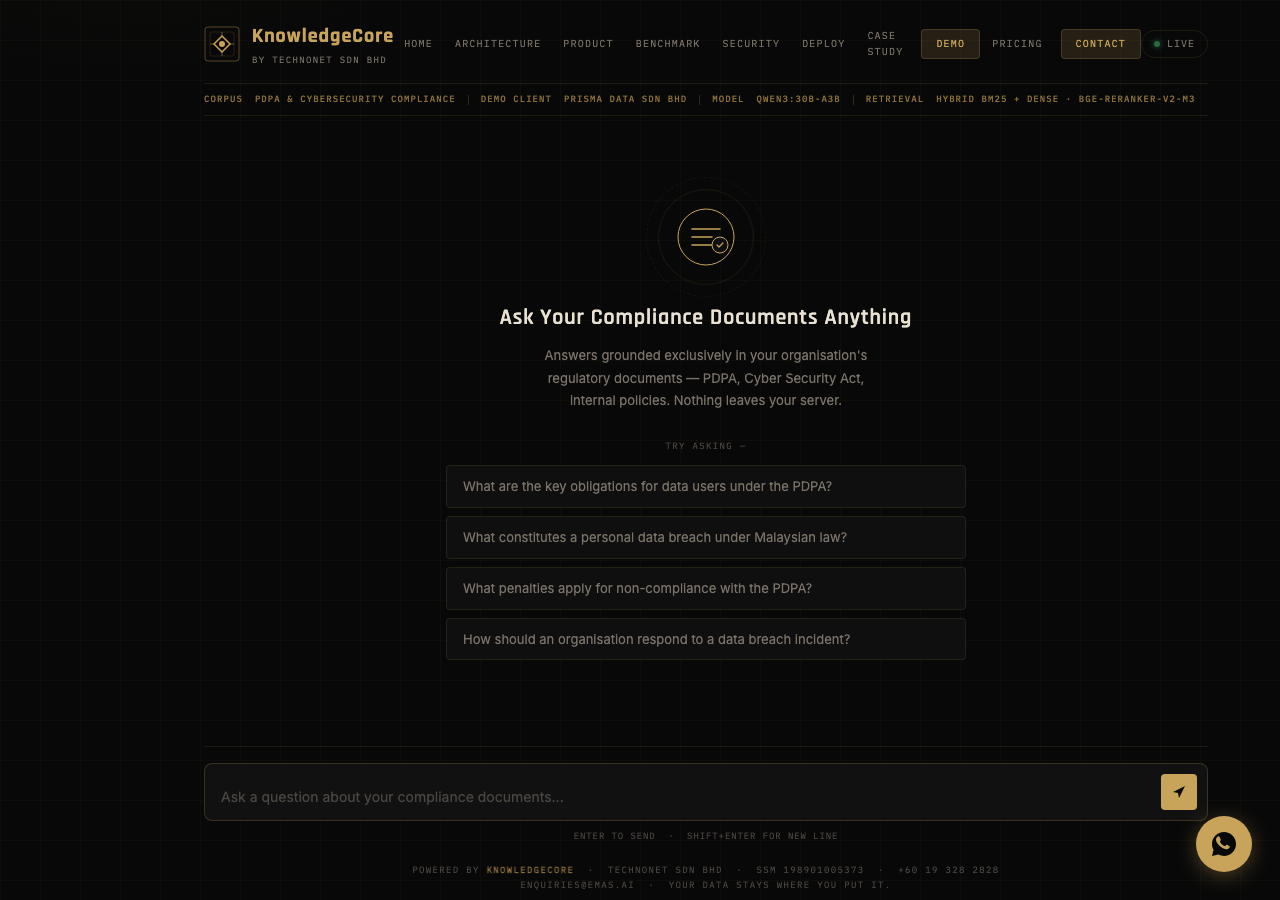
The interface opens with suggested questions drawn from your corpus. Users type a question in the input field — no special syntax required. The system shows the tenant and AI model in the status bar.
Screen 2 — Streaming answer with sources
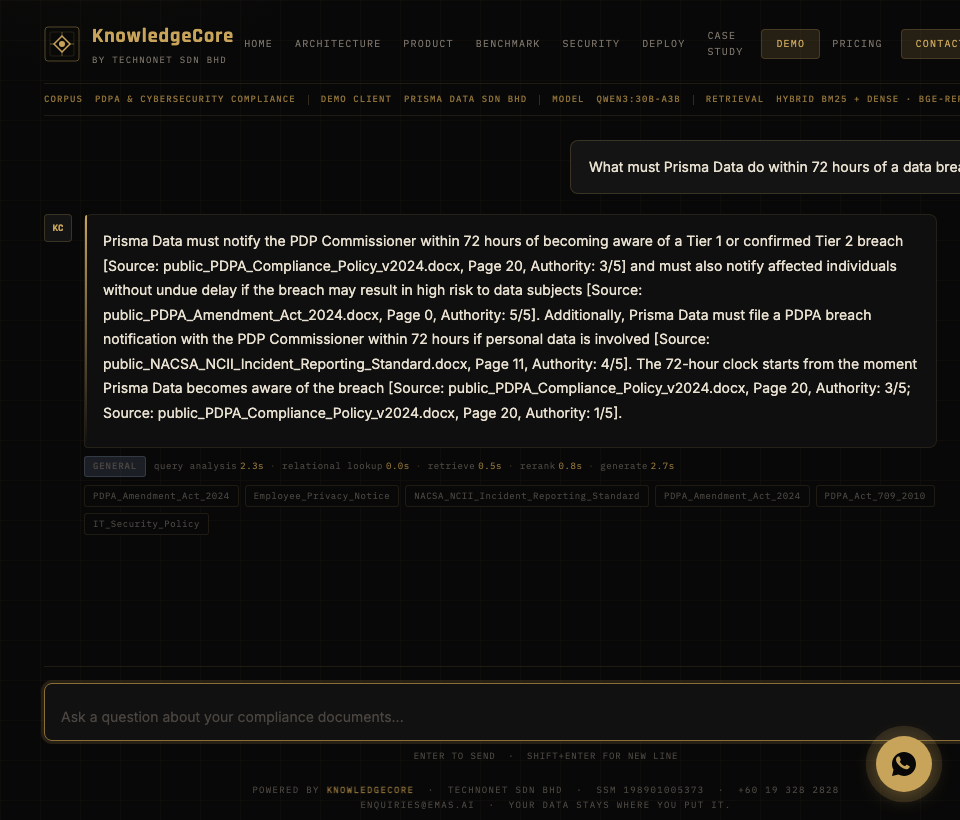
Answers stream token-by-token — first words appear within 3 seconds on recommended hardware. Source documents are listed as chips at the bottom of the answer. Inline citations (e.g. "[Source: public_PDPA_Amendment_Act_2024.docx, Page 0, Authority: 5/5]") appear within the answer text itself.
Screen 3 — Multi-source synthesis
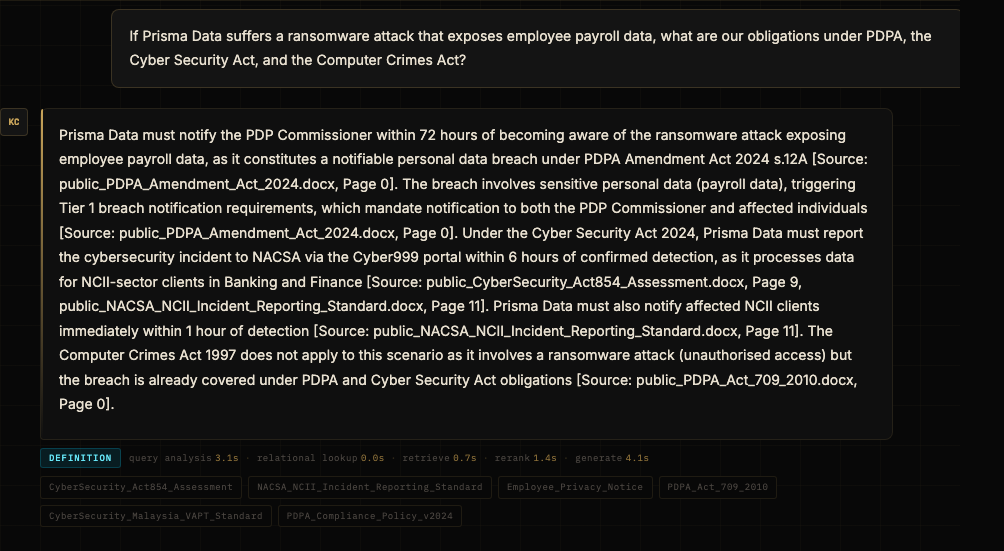
For questions that span multiple Acts or policies, KnowledgeCore draws from all relevant sources in a single answer. Sources from different documents are cited inline — the user sees exactly which document contributed which fact.
Screen 4 — Out-of-corpus refusal
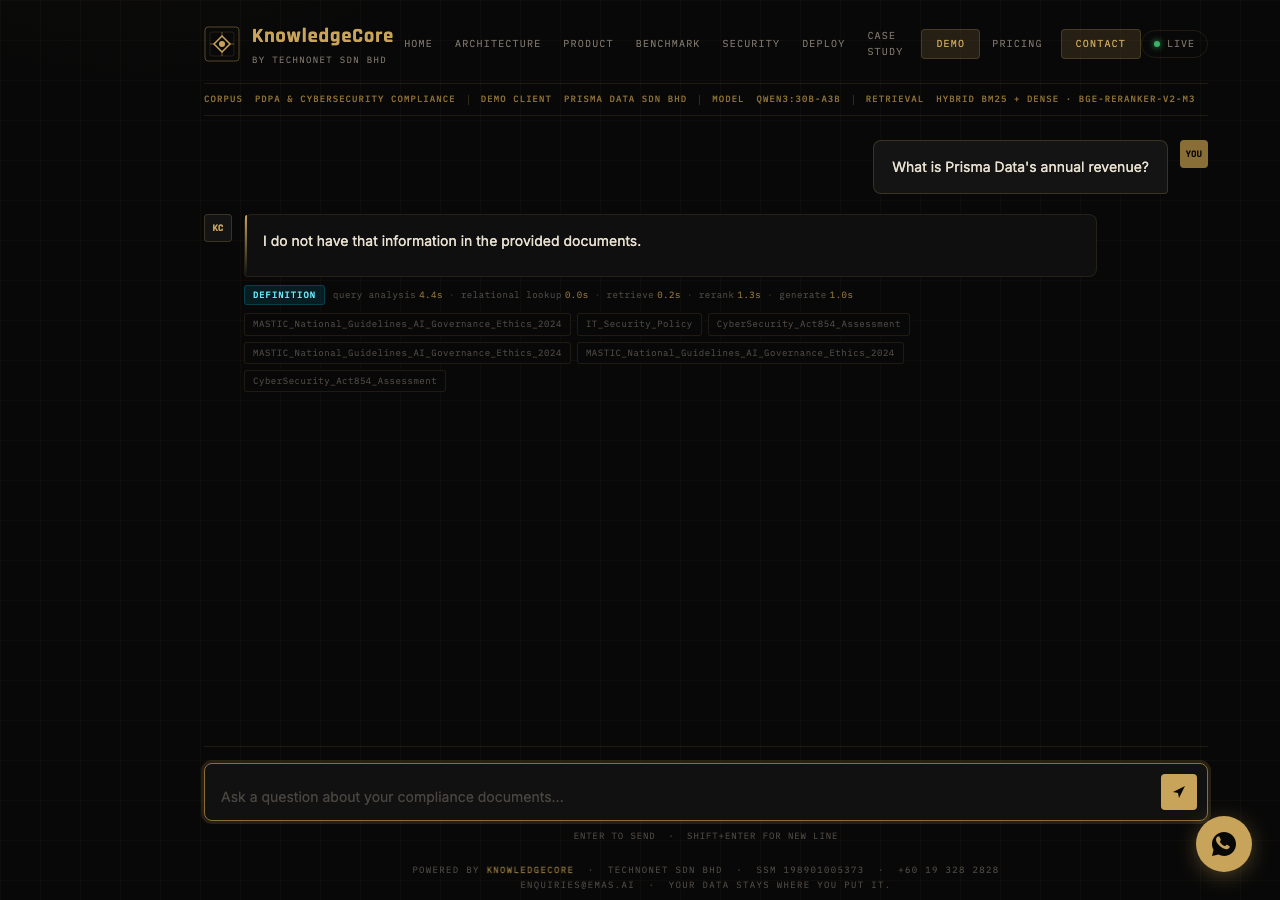
When a question asks about content not in the ingested documents, the system says so — it does not guess or fabricate. This is a deliberately designed behaviour, not a bug. Faithfulness score is 1.000 in production benchmarks — no hallucinated facts.
Screen 5 — Agentic pipeline trace
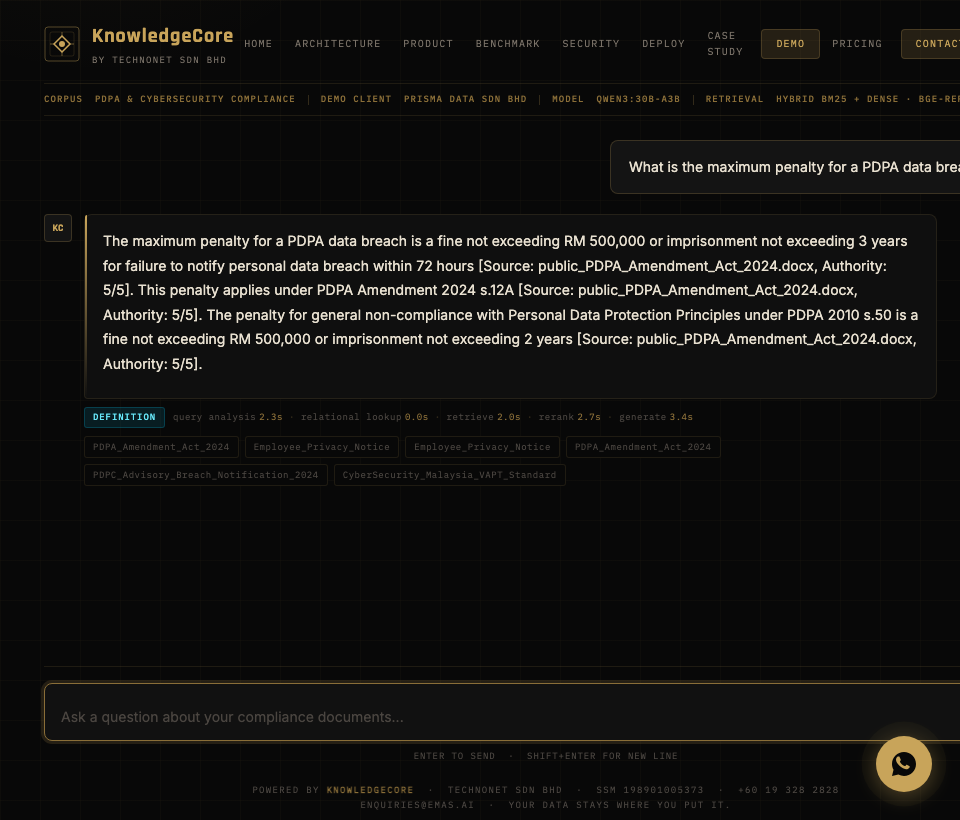
Every answer shows the full pipeline trace below the response — intent classification, relational lookup, retrieval, reranking, and generation, each with its elapsed time. Source documents are listed as chips. Users see exactly where their answer came from and how long each step took.
Screenshots are taken from the live demo system. The demo runs on the Prisma Data PDPA corpus. To see the product in action on your own documents, book a setup session — we can do a proof-of-concept ingest in under a day.
Capabilities and limitations
What it does well — and what it doesn't.
KnowledgeCore is designed for one job: answering questions from documents accurately with full citations. It is not a general-purpose AI assistant, a search engine, or a document management system.
| Capability | Status | Notes |
|---|---|---|
| Plain-language questions answered with citations | Full | Core function. English optimised, Bahasa Malaysia evaluation in progress. |
| Multi-document cross-referencing in one answer | Full | Answers draw from all relevant documents in the corpus simultaneously. |
| Hallucination refusal (out-of-corpus) | Full | Faithfulness 1.000 in production benchmarks. |
| Streaming responses | Full | First token in under 3 seconds on recommended hardware. |
| PDF ingestion (text-layer) | Full | Including multi-column layouts and footnotes. |
| DOCX, XLSX ingestion | Full | Tables and structured data preserved. |
| Relational fact extraction | Full | 24 relation types extracted and stored. Enables precise numeric and definitional answers. |
| Arithmetic on extracted facts | Full | e.g. "What is the change in penalty from 2010 to 2024?" — calculated, not guessed. |
| Response cache | Full | Identical questions answered from cache in under 0.1 seconds. |
| Clarifying questions for vague queries | Full | AG-4 Clarification Agent fires when the query lacks a specific anchor. |
| Scanned PDFs (image-only) | Add-on | Requires OCR pre-processing. Available as a professional services add-on. |
| Bahasa Malaysia queries and corpus | Evaluation | bge-m3 is multilingual. Formal BM evaluation in progress. |
| Charts and diagrams in PDFs | Roadmap | Only text content is indexed. Chart data (if available as text) is captured; visual elements are not. |
| General knowledge (beyond ingested corpus) | Not supported | By design. The system only answers from your documents. It refuses questions it cannot ground in the corpus. |
| Web search / internet access | Not supported | By design. KnowledgeCore is air-gap capable and never calls external services during operation. |
| Image, audio, video analysis | Not supported | Text-only ingestion. Transcripts can be ingested after pre-processing. |
Concurrency and scale
How many people can use it at once.
| Hardware tier | Concurrent users | First-token latency | Notes |
|---|---|---|---|
| Minimum (32 GB) | 1–3 | 15–25 seconds | CPU inference. Suitable for PoC or single-user DPO desk. |
| Recommended (64 GB, GPU) | 4–12 | 3–7 seconds | GPU-accelerated inference. Suitable for a compliance team of 5–10. |
| Enterprise (128 GB+) | 20–100 | <3 seconds | Multiple parallel inference slots. High-concurrency regulated sector deployment. |
| Response cache (all tiers) | Unlimited | <0.1 seconds | Previously asked questions answered instantly from Redis. Cache TTL is 1 hour by default. |
Latency figures are from production benchmarks on Apple Silicon M5 Max (recommended tier). Linux CUDA deployments on equivalent GPU have similar latency profiles.
Common questions
What buyers ask most.
| Question | Answer |
|---|---|
| Can users ask follow-up questions? | Yes. Each conversation maintains context — follow-up questions reference prior answers in the same session. |
| How do we add new documents? | Copy the file to the ingest directory and run the ingest command. New documents are indexed in minutes and immediately available to query — no restart required. |
| Can different teams access different documents? | Yes, via tenant isolation. Each tenant has its own document corpus, and a user's API key only queries their tenant's data. Department-level RBAC is on the roadmap. |
| What if someone asks about something not in our documents? | The system says "I do not have information on that in the available documents." It does not guess, hallucinate, or use external knowledge. This is a hard-coded safety behaviour. |
| Is there a web interface or is it API-only? | Both. The web interface (like the demo you can try) is included. The API is available for embedding KnowledgeCore into your existing systems, portals, or Slack bots. An MCP server for Claude Desktop integration is also included. |
| How large can the document corpus be? | Tested with corpora up to 50,000 pages on enterprise hardware. For the recommended tier (64 GB), up to 5,000 pages gives optimal retrieval performance. There is no hard limit — storage is the binding constraint. |
See it working on a real corpus.
Try the live demo with Malaysian PDPA compliance documents, or talk to us about running it on yours.